The Irish Story

The Irish War of Independence – A Religious War? Part III

In this concluding part of a three-part series, we talk about the results of the Irish Revolution and the partition of the country between North and South.
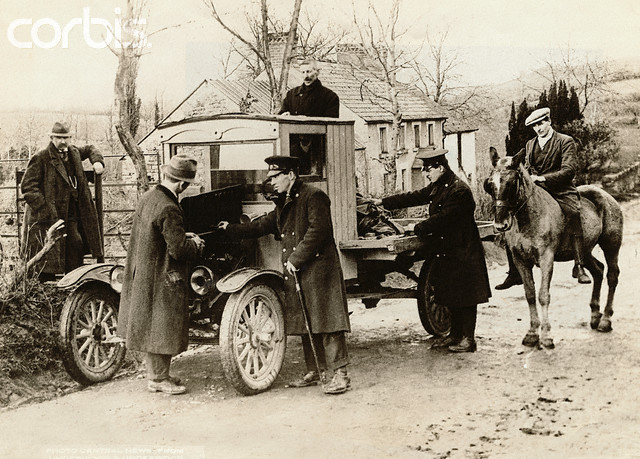
Free State troops man the new Irish border in 1922

Firstly, Fearghal McGarry strikes a cautionary note. Although we in Ireland might look back and shudder at political violence in our twentieth century, it amounts to no more than a drop in the ocean compared to the century’s other instances of war, massacre and population displacement.

McGarry Comparison

Here, we discuss the results of the War of Independence, firstly discussing the departure of some 40,000 Protestants from the south of Ireland after independence and the contrast between the two post-partition Irish states – the Irish Free state and Northern Ireland.

War of Independence 3

Contributors here are, in order, Fearghal McGarry, Niall Meehan and John Borgonovo. Questions by John Dorney.

Finally, long after the dead had been buried and the rifles had rusted in storage, the Irish War of Independence became the field for a furious war of words over whose interpretation of Irish history would predominate. Here we discuss the so called “nationalist” versus “revisionist” debate.

It’s worth bearing in mind that, as our contributors point out, the “History Wars” were conducted against the backdrop of actual armed conflict in the North. An influential body of opinion in the south took the view that nationalist history as whole was partly to blame for republican violence and also that it had obscured the complexity and nuance of real as opposed to mythological Irish history.

History Wars

Contributors; John Borgonovo, Fearghal McGarry and Niall Meehan.

Part I Before the Revolution

Part II Religious War?

9 Comments

  1. Anonymous
    August 23, 2010

    [...] [...]

  2. Terry Quinn
    August 23, 2010

    Excellent series. I’m afraid though the history wars are far from dead when Niall Meehan can state that Northern Ireland was an apartheid state. The North was certainly a sectarian state that discriminated against Catholics. But Catholics had the vote in national and Stormont elections (the discrimination in local government elections was based on property and applied equally to working class Protestants) and the gap between the two communities was nothing like that in South Africa.
    Under Apartheid 19 million blacks were denied the vote by 4.5 million whites. Whites owned or were allocated 87% of the land of South Africa and controlled 75% of the national income. The black infant mortality rate was 40% in rural areas compared to 2.7% for whites. Spending on education was $696 per white child and $45 per black child. Inter marriage between the races was outlawed and all citizens classified according to race. Pass books controlled where blacks could travel to and where they could live.
    That simply was not the situation in Northern Ireland (and I write as someone from a northern nationalist background). Some people frowned on inter-community relationships but they were not illegal and they were widespread in the 1960s. There is no point exaggerating. When Fr. Alex Reid compared Unionists to the Nazis in 2005 Eamonn McCann wrote a good article where he stated that he still resented the discrimination that he faced growing up in Derry in the 1950s, but that he didn’t grow up in the Warsaw Ghetto and to pretend that the North was like that was an insult to the victims of Nazism. Ditto Apartheid.

  3. John_Dorney
    August 23, 2010

    Thanks Terry, insightful comments there.

  4. Niall Meehan
    August 30, 2010

    Thanks for bringing in the Nazi comparison (I didn’t).

    Is that because apartheid was not as bad a Nazism but on a continuum which allows a comparison of some kind to be made? Comparisons are not exact, so when unionists voiced concern in the 1960s for white Rhodesians it was on the basis of fellow feeling, not that Rhodesia was the same as Northern Ireland, but that certain valid comparisons could be made, they felt, between the two regions.

    Unionists in northern Ireland excluded the nationalist population from equality of representation (the property qualification in local elections was merely one aspect, that was maintained in order to negatively affect nationalists, despite also affecting less – comparatively – poor unionists), employment and housing. They were quite successful.

    Not merely action, but ideology played its part, an ideology of reactionary anti-Catholicism as virulent as racist ideologies in the southern USA and in South Africa. The Ulster Unionist party debated between 1959-61 whether to allow Roman Catholics to join. After a great deal of soul searching it was decided to maintain the status quo, exclusion. Northern Ireland’s longest serving and last Prime Ministers, Sir Basil Brooke and Brian Faulkner, concurred. Such was their contribution to the swinging sixties.

    In 1963 the then South African Minister for Justice, later Prime Minister, Balthazar Johannes Vorster, introduced new coercion measure in the South African House of Assembly. Vorster claimed that he ‘would be willing to exchange all the legislation of that sort, for one clause of the [Northern Ireland] Special Powers Act’. The Special Powers Act specified numerous activities as subject variously to punishment by hanging, flogging or long terms of imprisonment. Vorster’s preferred clause (Section 2.4) stated:

    ‘If any person does any act of such a nature as to be calculated to be prejudicial to the preservation of the peace or maintenance of order in Northern Ireland and not specifically provided for in the regulations, he shall be deemed to be guilty of an offence against the regulations.’

    At the time international and liberal attention was focused on the South African Apartheid regime, recently departed from the British Commonwealth. It was the only type of international solidarity unionists were likely to receive, and some, it should be emphasised, had no difficulty accepting it. In the midst of this concern, it appeared that Britain had a mini South Africa on its doorstep, one whose jurisdiction, unlike in South Africa, it controlled. South African endorsement was not appreciated by British policy makers, not least since it was picked up in the Soviet Union, which referred to Northern Ireland as a ‘white Africa’ (Times (Lon), Dec 3, 1968).

    In 1972 a founder member of the Irish Anti-Apartheid movement, the Presbyterian clergyman, the Reverend Terence McCaughey, said ‘the sufferings of the peoples of Africa and of the North could be seen as part of a single international phenomenon. Members of the Irish Anti Apartheid movement are naturally people whose sympathies are not confined by national boundaries. At this moment in Irish history, however, we need no excuse for directing their attention to the plight of those in the North of Ireland whose breadwinner has been interned or detained without charge or trial’ (NI situation compared to Africa, The Irish Times, February 3 1972).

    So, I think the comparison, while not exact, is valid, part of a continuum.

  5. Terry Quinn
    August 31, 2010

    Vorster was taking the piss Niall. He was reacting to British criticism by saying, ‘hey, you think we’re bad, but look at what your own United Kingdom does.’ The last floggings in the north occurred during the Second World War. Could you tell me how many Catholics the B-Specials killed between 1922 and 1969? I would be very surprised if it was more than single figures- I can only ever remembering hearing of one case in the 50s (I think). I think the South African police would come off worse from any comparison. Apartheid simply does not describe the life that Catholics had in the north prior to 1969. Were we second class citizens? Yes, in lots of ways. But we weren’t inferior under the law and we intermingled with Protestants in ways that blacks and whites simply could not in South Africa. Look up Gerry Adams memoirs about the boys and girls of Ballymurphy and Springmartin for instance. Catholics owned most of the pubs in Belfast in the 60s, including those in loyalist areas (many were destroyed in 1969). Did blacks in South Africa run many businesses in white areas? Hyperbole does no one any good.

  6. [...] Part III Sectarian States? // Share| Tags: Ancient Order of Hibernians, Catholic Protestant, class, Cork, Dublin, Fearghal McGarry, Fenians, IRA, Irish Church Mission, Irish Parliamentary Party, Irish War of Independence, John Borgonovo, Monaghan, Niall Meehan, Padraig Yeates, religion, Republicanism, sectarianism, Sinn Fein [...]

  7. [...] III Sectarian States? // Share| Tags: 1919, 1920, 1921, 1922, Anglo Irish War, Army, B Specials, Belfast, Belfast [...]

  8. Francis
    October 17, 2010

    Has Unionist concern expressed in the 1960s about white Rhodesians not turned out to be justified? I fully supported the anti-Apartheid struggle in South Africa, but am not at all happy with some of the measures taken by Robert Mugabe in Zimbabwe.

Leave a Reply